NFC Door Lock and Smart Lock with NFC: How Tap-to-Unlock Works
How an NFC door lock and a smart lock with NFC work, what to compare, and whether an NFC credential is the right fit for a home, office, or shared door.
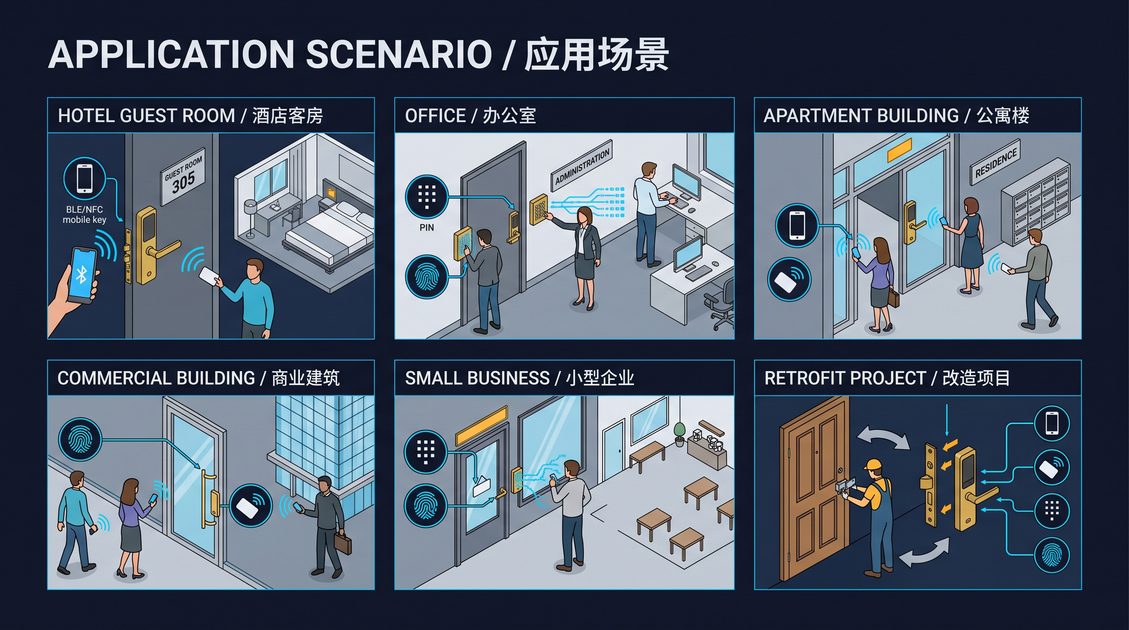
An NFC door lock is a smart lock that unlocks when you tap a credential, most commonly a phone or a card, on the lock's near-field communication reader. NFC, near-field communication, is a very short-range radio used for tap-to-pay and tap-to-unlock, and on a door lock it provides a fast, deliberate, and battery-friendly credential that is harder to trigger accidentally. This guide explains how an NFC door lock and a smart lock with NFC work, what to compare, and whether NFC is the right credential for your door.
How an NFC Door Lock Works
An NFC door lock reads the credential from a phone or card when it is tapped or held within centimeters of the reader. The lock compares the credential against its authorization table and unlocks if valid. Because NFC range is so short, the user must deliberately bring the phone or card to the reader, which makes an NFC door lock more deliberate than a Bluetooth proximity unlock and less prone to accidental activation while still being faster and more convenient than typing a code.
A smart lock with NFC typically holds the credential on the phone, so a phone replaces a key or card, and it can manage multiple credentials and issue them to others through an app. NFC is also common on cards and fobs using the same contactless standard as other access systems, so an NFC door lock can accept a card or fob as well as a phone. The short-range, deliberate nature of NFC makes it both secure against accidental unlock and battery-friendly, because the reader only powers up when a credential is near.
Comparing NFC and Choosing
When comparing an NFC door lock, the key criteria are the credential types, fallback, battery, and security. Confirm the lock accepts the credentials you plan to use, whether a phone, card, fob, or a combination. Confirm it has a fallback, such as a keypad, fingerprint, mobile key, or mechanical key, because a user with a low phone battery or a lost device needs another way in. Confirm the battery arrangement and reporting. And confirm the credential is encrypted so the NFC identifier cannot be cloned by an interception or a simple reader.
An NFC door lock is a strong choice when you want a fast, deliberate, battery-friendly tap-to-unlock, especially in a setting where a phone is natural and where avoiding accidental unlocks matters. It fits a home with a tech-savvy household, an office where staff use phones, or a shared door where a card or fob is preferred. The trade-off is the deliberate reach-and-tap action versus the hands-free convenience of Bluetooth and the need to carry a device, so a fallback and central credential management are essential. Apply the same framework as any smart lock, and an NFC door lock will provide a secure, fast, low-power credential for its door.
Choose NFC for the deliberately quick tap and the low battery drain it brings, but verify the credential is encrypted so a nearby interception cannot clone it. Decide who can issue and revoke NFC credentials, and keep a keypad, fingerprint, or mechanical fallback for a visitor without a compatible device or a user with a drained phone. When the credential lifecycle and fallback path are in place, an NFC door lock is both secure and genuinely pleasant to use.
Verify that the NFC reader is positioned and powered so a quick tap is reliable for every user, including children, people with mobility aids, and visitors unfamiliar with the lock. The tap should require minimal pressure and provide clear feedback, and the lock should accept a fallback when a device is not available. A door lock that is fast for one person and frustrating for another is not yet finished, so test it with the real range of users.
A quick, deliberate tap is the right trade for many doors, and it becomes even better when the lock and its users are well matched.
Not sure which sensor fits your project?
Talk to our mmWave application engineers for a free consultation.
Specify your hotel project with our engineers
Send your room count, ceiling type, and protocol preference. We will return a sample plan and quote within 24 business hours.
- Move from general guidance into a product or application discussion.
- Use RFQ when pricing, drawings, MOQ, or launch timing needs structure.
- Keep a direct contact path visible for fast clarifications and handoff.