Multifamily Security Systems Guide: Protect the Whole Building
A multifamily security systems guide covering entry control, video, alarms, unit locks, and resident safety with a phased plan for apartment communities.
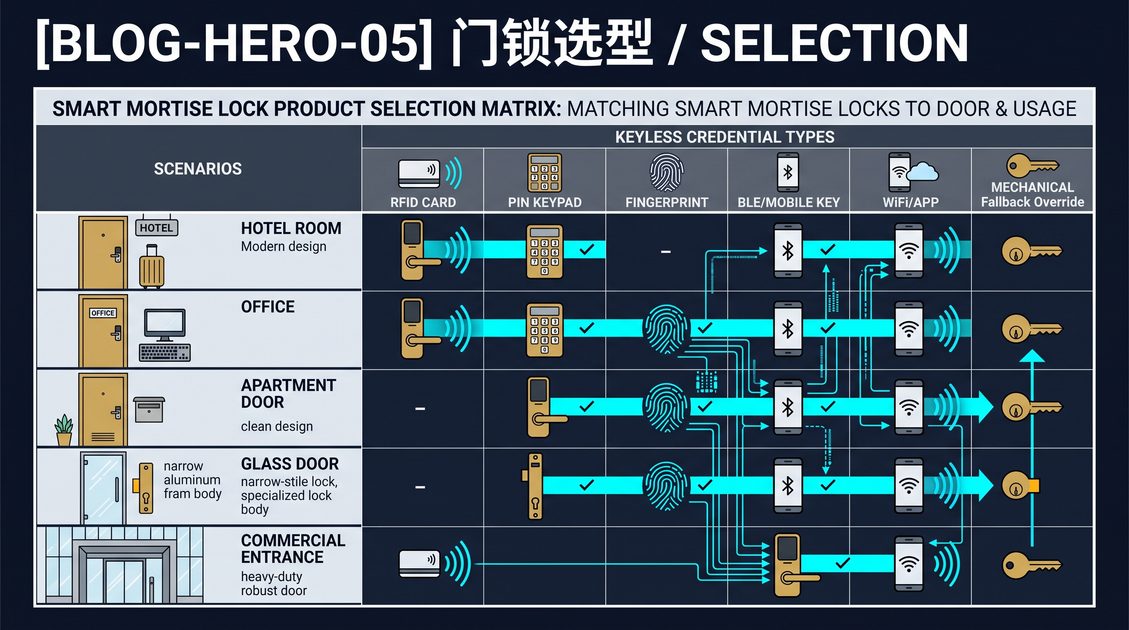
What a multifamily security system is
A multifamily security systems guide should define the integrated whole: a security system for an apartment community combines entry control, video surveillance, alarms, unit locking, and resident-facing communications so that the entire property, not just the unit door, is protected and observable. At the perimeter, the lobby entrance, parking gates, mailroom, and amenity doors filter who may come in. Video cameras record common areas and entry points, and alarms detect intrusion or the forced opening of a protected door. Inside each unit, the door lock and any window or door sensors guard the private space. The separate parts speak through a common platform that logs events, alerts staff, and lets residents request help. Designed as one layer-aware whole, the system closes gaps that isolated purchases routinely leave open between the front door and the individual unit.
Setting a security posture the community can sustain
A multifamily security systems guide succeeds only when it makes security sustainable rather than symbolic. Define the tier of deterrence and detection the community can afford to staff, operate, and maintain, because a camera that is never watched or a lock that is never provisioned contributes little. A realistic posture combines management for everyday risk, visible behavior such as a concierge or a monitored lobby during busy hours, and layered technical controls that reduce reliance on any single point. Because residents and staff must genuinely use the controls, the community should choose technologies that fit their habits, install them with clear signage, and budget for ongoing administration. A sustainable posture beats an elaborate but neglected one, and it keeps security feeling like a benefit rather than an imposition.
Entry control at the building and unit level
Entry control is the backbone of any multifamily security systems guide, and it operates on two distinct boundaries. At the building boundary, an intercom, reader, or staffed desk filters who gains the lobby and common areas. At the unit boundary, the resident's door lock grants the private threshold to those entitled to cross it. The strongest arrangements treat the two consistently, one credential (a card, fob, or phone) opens both the front door and the unit door, so a resident carries a single token and a contractor admitted to the building is not automatically inside a unit. Revoking access is then equally consistent: cancel the credential at departure and it stops working everywhere at once. This coherence is exactly what turns separate doors into a joined security system.
Common areas beyond the lobby
The hallway, mailroom, gym, laundry, storage, and parking are where a building's security often sags. A multifamily security systems guide should give these spaces explicit attention rather than leaving them to chance. Secure the points where residents assume safety, such as a restricted-access mailroom that keeps packages away from passers-by, and the parking, gates and elevator, where the same credential should verify entitlement to floors or levels. Regular patrol is more honest where full electronic coverage is not justified. Each added boundary must be administered and maintained, so add one only where it measurably reduces risk or satisfies policy. The result is a graded set of layers in which the sensitive interior is proportionally harder to reach than the public exterior.
Video surveillance that respects privacy
Cameras earn their place in a multifamily security systems guide when they deter incidents and preserve evidence without making residents feel watched at home. License the area where coverage is legally and socially appropriate, entry points, corridors, lobbies, parking, and other common spaces, and keep cameras out of private living areas and other places where recording is neither lawful nor appropriate. Aim for a visible, fixed deployment whose resolution and coverage are matched to the incident review the community actually does, and retain footage for a defined period under a documented policy. Mechanisms to store, restrict, and finally delete video, alongside clear signage, keep the surveillance proportionate and lawful. Video is one layer of the system, and it works best when it reinforces entry control rather than replacing it.
Alarms and sensors: detecting what cameras miss
A multifamily security systems guide should place alarms where they add information the other layers lack. Door and window contacts on unit entry points and on vulnerable perimeter doors report forced or unexpected openings, while motion sensors in low-traffic common areas can flag activity after hours. Alarm events should flow to the same platform that holds the entry and video logs, so staff can correlate a door alarm with a camera record and a credential attempt into one timeline. Consider centrally monitored alarm service where a staffed office cannot respond around the clock, and integrate emergency egress so that security hardware never traps occupants during a fire. Sensors are most valuable when they are supported and acknowledged, since an alarm that routinely yields no action quickly trains everyone to ignore it.
Securing the resident unit itself
The unit door is the last and most personal boundary, and a multifamily security systems guide should treat it as part of the community design rather than something each tenant handles alone. Invest in lock hardware that is genuinely hard to force, and back it with policies about rekeying or re-credentialing after each tenancy so that outgoing and incoming residents have complete separation of access. Reinforce the most common attack surfaces, such as a misaligned strike or a weak frame, and consider upgrading door hardware when a building-wide retrofit is already planned. Electronic locks that log entry events give residents and staff a record that discourages disputes and supports resolution when an incident does occur. A community that standardizes solid unit hardware across its units secures every occupant, not just the ones who take initiative.
Phasing, budgeting, and launching a community plan
Most communities cannot fund and install every layer at once, so a multifamily security systems guide should lay out a phased path. Start with the controls that reduce the clearest risk at the least cost, typically entry control and the lobby, add video at the highest-value common points, then layer alarms and unit-hardware upgrades as budget allows. Baseline each phase and measure it, such as the time to revoke a departing resident's access or the number of incidents reported, so that the next phase is justified by evidence. Budget for installation, licensing, consumables, and staffing from the beginning. Launch with resident communications that explain the new system, set expectations about data use, and invite feedback, since a community that understands its security system is far more likely to keep it strong than one that meets it as a surprise.
Not sure which sensor fits your project?
Talk to our mmWave application engineers for a free consultation.
Specify your hotel project with our engineers
Send your room count, ceiling type, and protocol preference. We will return a sample plan and quote within 24 business hours.
- Move from general guidance into a product or application discussion.
- Use RFQ when pricing, drawings, MOQ, or launch timing needs structure.
- Keep a direct contact path visible for fast clarifications and handoff.