Mortise Lock Replacement Guide for Smart Electronic Upgrades
A practical mortise lock replacement guide covering door surveys, compatibility, retrofit decisions, credential choices, installation, testing, and lifecycle planning for smart upgrades.
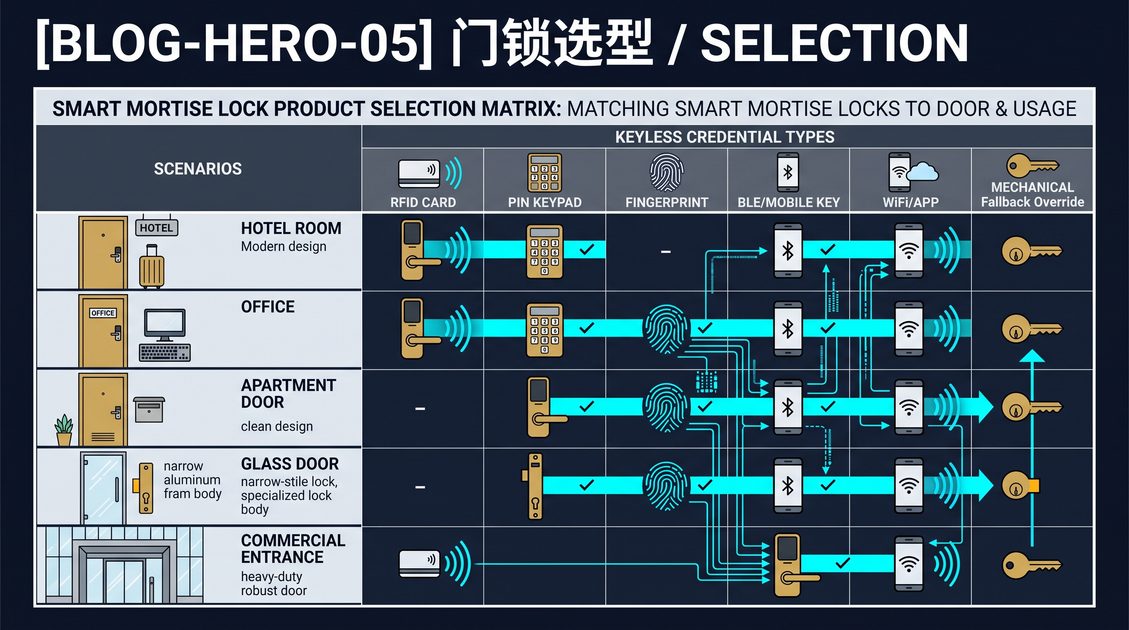
A mortise lock replacement is the process of removing an existing lock body and fitting a new mechanical or electronic mortise lock into the door pocket. For a smart upgrade, replacement also includes choosing credentials, power, connectivity, software, and an emergency-access path. Compatibility depends on the lock-body dimensions, backset, faceplate, handing, strike, door thickness, handle spacing, frame condition, and any fire or accessibility requirements. This mortise lock replacement guide provides a practical method for deciding whether a drop-in replacement is possible, when door modification is required, and how to migrate users without creating a lockout or security gap.
Mortise Lock Replacement Guide: Identify the Existing Hardware
Start by photographing and measuring the existing opening before removing anything. Record the lock-body height, width, and depth, the faceplate shape, backset, handle and cylinder positions, spindle size, strike location, door thickness, and handing. Check whether the existing case has a deadbolt, latch, privacy function, or multipoint connection. The replacement must match the door and frame as an assembly; a compatible lock body cannot correct a weak frame, a warped door, or an incorrectly positioned strike.
For an electronic replacement, identify available power and communication options. A battery-powered lock may require no cabling, while a wired or gateway-based system may need protected conductors and a suitable route through the door. Record the current key or card process and determine whether existing users need to be migrated to PIN, RFID, fingerprint, or mobile credentials.
Mortise Lock Replacement Guide: Drop-In or Modification
A drop-in replacement reuses the existing pocket and usually minimizes labor, finish damage, and downtime. It is the preferred route when the new electronic mortise lock matches the case dimensions, faceplate, strike, and handle geometry. A modification project is different: enlarging a pocket, moving a strike, drilling new holes, or changing the door furniture may require specialist tools and can affect a rated door or warranty.
Do not assume that a product described as a retrofit lock will fit every mortise opening. Request the manufacturer’s dimensional drawing and compare it with the measured opening. For a multi-door project, survey representative doors from each construction batch because hotel, apartment, and commercial properties often contain several hardware variations.
Mortise Lock Replacement Guide: Plan the Credential Migration
Credential migration should be treated as an operational project. Decide which users receive access, which doors each group can open, when credentials expire, and how lost credentials are revoked. If the old system uses keys, plan a controlled key transition rather than distributing electronic credentials without a revocation policy. If it uses cards, determine whether the new reader accepts the same card technology; do not assume that every RFID card is interoperable.
Retain a documented emergency credential and a mechanical recovery method during the transition. Installers should use separate configuration accounts from daily administrators, and the property should keep a door-by-door record of the new lock identifier, firmware, owner, and recovery procedure.
Mortise Lock Replacement Guide: Install and Test
Remove the old case carefully and protect the door edge and frame. Fit the replacement lock, faceplate, strike, handle, reader, and cylinder according to the current manufacturer instructions. Operate the door mechanically before applying power. The latch and bolt should move smoothly, the door should close without excessive force, and the strike should not scrape or force the actuator to work against misalignment.
Test valid, invalid, expired, and revoked credentials with the door open and closed. Test inside egress, manual override, auto-lock if enabled, low-battery warning, backup power, and network loss. For a property-wide replacement, pilot a representative set of doors before approving the full rollout.
Mortise Lock Replacement Guide: Lifecycle Decisions
A replacement should improve serviceability as well as access. Confirm that batteries, readers, handles, spare parts, firmware, and documentation will remain available for the planned service life. Ask how the system reports low battery, how administrators recover access, and how audit data is exported. For a commercial or hotel deployment, confirm support and training before the old system is removed.
This mortise lock replacement guide is general information. Local fire, accessibility, privacy, electrical, building, and emergency-egress rules may require qualified review, particularly when modifying rated or emergency doors. Choose a replacement only after verifying the exact opening and the complete operating context.
Not sure which sensor fits your project?
Talk to our mmWave application engineers for a free consultation.
Specify your hotel project with our engineers
Send your room count, ceiling type, and protocol preference. We will return a sample plan and quote within 24 business hours.
- Move from general guidance into a product or application discussion.
- Use RFQ when pricing, drawings, MOQ, or launch timing needs structure.
- Keep a direct contact path visible for fast clarifications and handoff.